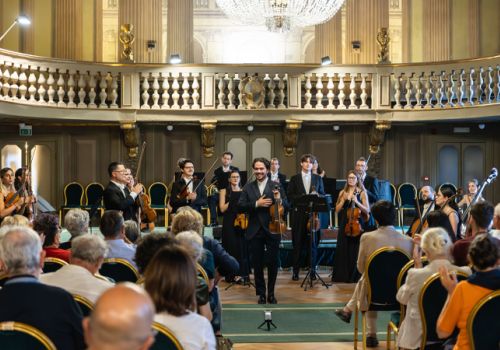
Mozart Evenings Marks Penultimate Evening with Tommaso Benciolini, Mirjam Schröder and L’Appassionata Orchestra
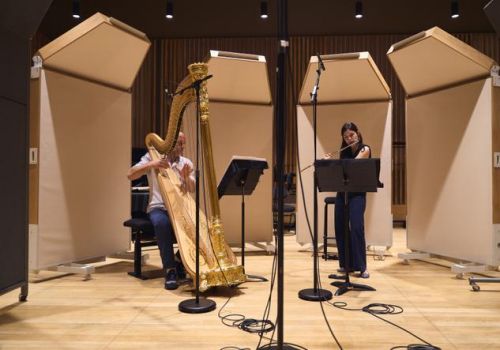
With this third edition of Mozart Evenings, organised by CMDI, the Gaspari Foundation, and the Comune di Verona, now nearing its conclusion, audiences in Verona were treated to a memorable concert on Wednesday 17th June, as the festival marked its penultimate entry with a performance featuring two acclaimed soloists, namely flautist Tommaso Benciolini (Italy) and harpist Mirjam Schröder (Germany), alongside the musicians of the L’Appassionata Orchestra (Italy).
Benciolini, who also serves as the Artistic Director of Mozart Evenings 2026, is closely connected with Verona, having graduated from the Conservatorio “E. F. Dall’Abaco” in the city with highest honours before continuing his studies internationally. Schröder, meanwhile, is one of Europe’s most distinguished harpists and educators, currently serving as Professor of Harp at the University of Music and Performing Arts Vienna.
For this occasion, which continued the five-day celebration of Wolfgang Amadeus Mozart that has now been taking place at Verona’s spectacular Sala Maffeiana since the 14th of June, the two soloists and the ensemble brought to life a programme that combined Mozart’s youthful and mature voices, juxtaposing the delicate colours of the flute and harp.
“It is a very special feeling to perform with L’Appassionata, the orchestra I founded some years ago”, Benciolini said. “I would say this is one of the most special occasions in which I like to play, so I am really excited and very happy, especially because I will share the stage with the wonderful harp soloist Mirjam Schröder from Vienna. She is a professor in Vienna and an amazing harp soloist, and together we are going to share the beauty of Mozart’s double concerto for flute and harp, which is one of Mozart’s most iconic and special masterpieces. It is also the only piece he wrote for harp, so it is a great pleasure and honour to play it tonight with Mirjam.”
The programme opened with Mozart’s Divertimento for Strings in D major, K.136, one of the composer’s most beloved Salzburg works. Written when he was still in his teens, the piece is full of brightness and charm, while also revealing the remarkable polish of Mozart’s early string writing. In the hands of L’Appassionata Orchestra, it offered a lively opening, immediately drawing the audience into the beauty of Mozart’s world.
“Being from Verona, I feel very lucky to be part of this project together with L’Appassionata”, said Anna Pasetto, a violinist with the orchestra. “Playing Mozart is always fascinating, because his music is simple in its perfection. It can be very demanding, but at the end of the day I always try to remember to have fun with it. To be able to play this Concerto for Flute and Harp is always very interesting, because you hear the different timbres and colours of these instruments together with the strings, and together with the colour of our orchestra. I am very happy to be here, and I’m very grateful to the people who are making it happen, so thank you to the Gaspari Foundation, to CMDI, and to Mr Ishkhanov for supporting this great project!”
The Divertimento was followed by the Symphony No. 11 in D major, K.84, another early work that continued the evening’s focus on Mozart’s youthful orchestral language, while showcasing his command of form and rhythm. At the centre of the evening, meanwhile, was the Concerto for Flute and Harp in C major, K.299, which was composed in Paris in 1778, on a commission by Adrien-Louis de Bonnières, a flutist, who wished to play it alongside his eldest daughter, Marie-Louise-Philippine, who was a harpist. Representing the only piece of music by Mozart for the harp, the concerto remains one of Mozart’s most enchanting works, written for a combination of solo instruments that was still relatively rare at the time.
“It is really a great honour to play in this hall, where Mozart himself performed”, Schröder declared. “I love Mozart’s Concerto for Flute and Harp, and it is so inspiring to be in a place where he played. The acoustic here is very good, and the city of Verona itself is so inspiring, with all its history. The festival is so full of life. All the musicians are here with a lot of energy; I also listened to yesterday’s concert, and it was played with so much love for Mozart’s music, so it’s all very inspiring for me!”
“This is the first time I am collaborating with Tommaso and with L’Appassionata” she continued. “I did not know them before, so I am very happy to have been invited here, and I hope it will not be the last time. I think it is very important to organise festivals like this, so thank you to CMDI, to the Gaspari Foundation, and to Mr Konstantin Ishkhanov for their hard work. In our time, we are not really used to being calm and listening, and I think that is something classical music can teach us. Being here and listening to music from another time, with another way of thinking and another sense of time, can change our minds.”
After the chamber intimacy of the previous evening, this fourth concert opened up another side of Mozart’s genius, one defined by lightness, dialogue, and instrumental colour. It was a combination that resonated well with the audience members in the hall, many of whom continued applauding long after the final note had dissipated. “I saw the sign about Mozart, and immediately knew I had to come because I have a special history with him” declared Peter De Groot, who travelled to Verona all the way from the Netherlands. “it is so important to continue hearing Mozart’s music performed live. I played in an orchestra myself, and there can sometimes be a problem with younger audiences, but I think Mozart is eternal. There can be a dip, but I am sure his music will always be there. This music, and this hall, are so very important.”
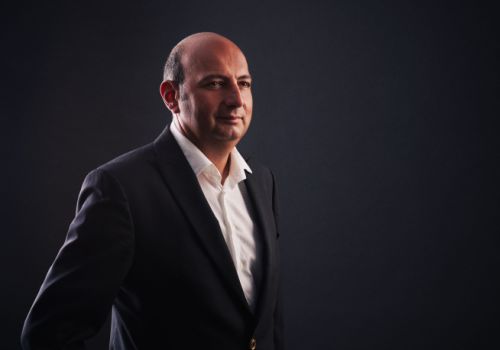
As Konstantin Ishkhanov, President of Mozart Evenings, remarked after the concert, “tonight’s performance showed another beautiful dimension of Mozart’s music, and I would like to congratulate Tommaso Benciolini, Mirjam Schröder, and the L’Appassionata Orchestra for creating such a special atmosphere in the Sala Maffeiana. It was a pleasure to see people gathering from all around the world for such events, and responding so warmly to this music. As we approach the final concert, I believe this edition has already shown the richness of Mozart’s world and the importance of continuing to celebrate it with artists of such calibre!”
Mozart Evenings 2026 now moves to focus on its final concert, which will take place on Thursday 18th June, and will feature the L’Appassionata Orchestra alongside the acclaimed violinist Giuseppe Gibboni (Italy), in a programme including Mozart’s celebrated Eine kleine Nachtmusik, K.525, and the Violin Concerto No. 4 in D major, K.218.